
Impacts of Acidification on Atlantic Sea Scallops
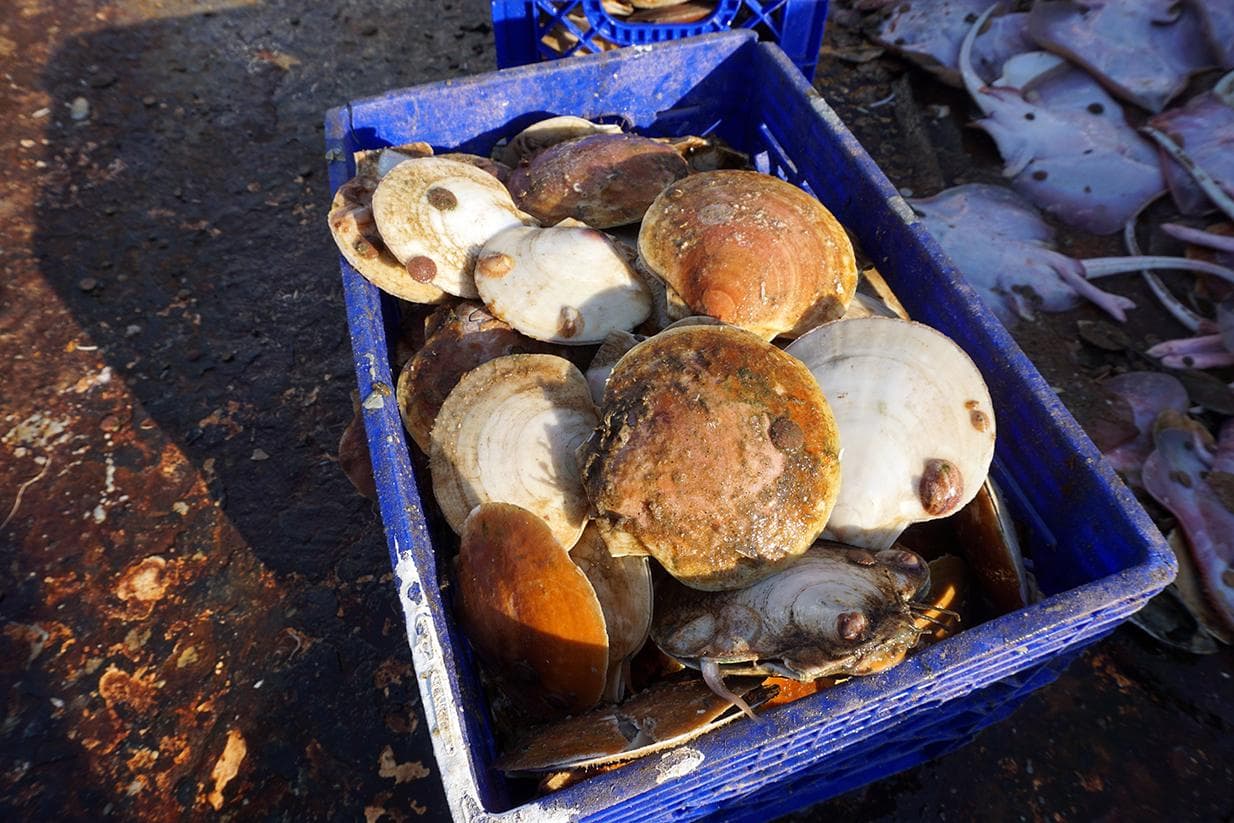
The Atlantic sea scallop (Placopecten magellanicus) fishery is one of the most economically important fisheries in the Mid-Atlantic, generating $46 million and producing 1,400 metric tons of meat in 2024. Acidic events encountered by scallops during their larval transport may threaten population resilience by increasing mortality and reducing growth, especially given the Mid-Atlantic stock’s dependence on recruits from northern scallop beds. This project investigates the impact of acidic events on scallops in the Mid-Atlantic by integrating biological (VIMS Scallop Dredge Survey) and carbonate chemistry (MACAN). We examine the potential effects of acidic events on the shell height-meat weight relationship under a Bayesian paradigm. A new data layer and “Ocean Stories" post on MARCO's Mid-Atlantic Ocean Data Portal will be available in early 2027.
Preliminary Results
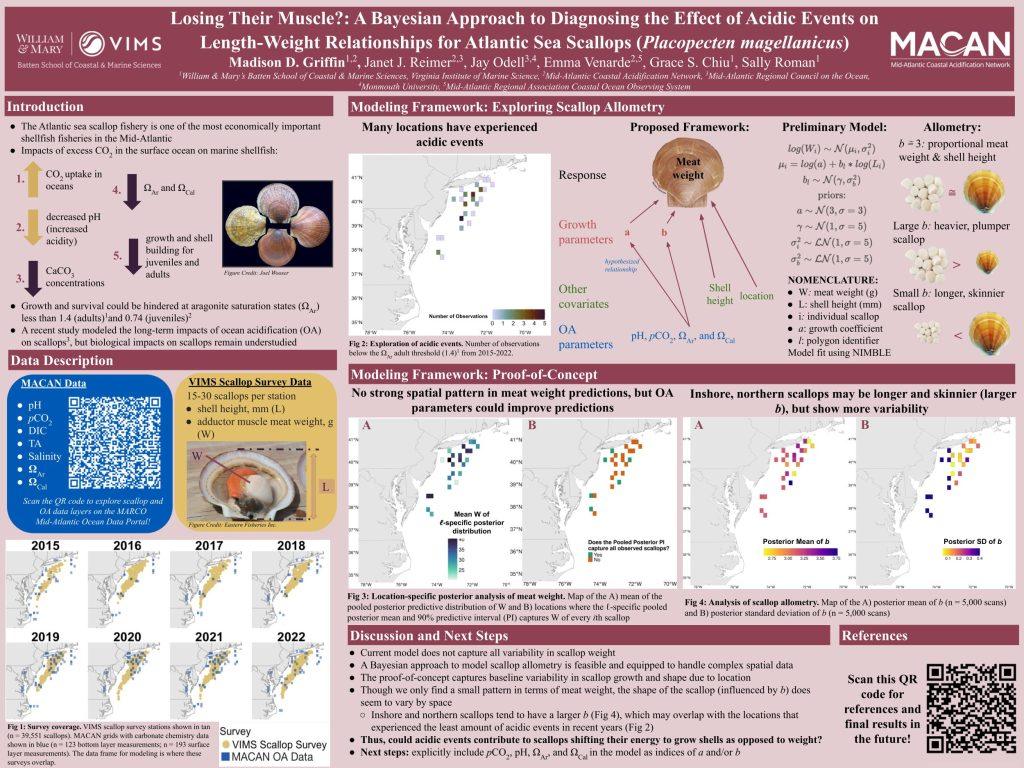
Click the buttons below for two versions of a scientific poster reflecting preliminary results. View the left poster for a statistical focus and the right poster for a biological focus.
References
Madison Griffin
Madison Griffin’s dissertation research at the William & Mary Batten School of Coastal and Marine Sciences at VIMS applied statistical approaches to address complex ecological problems and inform policy and management. She holds a B.S. in Biology with a concentration in Marine Biology from Duke University. At VIMS, she developed a novel method using Gaussian mixture modeling to conduct a cohort analysis of oyster reefs in Chesapeake Bay, which identified older, yet smaller, oysters, an important signal of resilience in the oyster reef population. She uses those cohorts to develop statistical methods to quantify resiliency and communicate with policy stakeholders. Throughout her MACAN Fellowship, she will develop skills in applied science for resource management. She will deepen her knowledge of COA and commercial shellfish fisheries by investigating the impact of acidic events on the shell height-meat weight relationship of Atlantic sea scallops, an organism whose response to COA is understudied in the literature. Madison plans to have a career in fisheries and resource management.

Get Involved
If you are interested in learning more about MACAN and the work we do, please sign up for our monthly newsletter. You can also read our 2024 to 2028 Work Plan.


The Mid-Atlantic Coastal Acidification Network. All Rights Reserved.